Author: Susan Gasson

  • Organizational Coordination

    Organizational Coordination

    I have been working for a while on comparing the results from some very complex research studies of collaborative design in groups that span disciplines or knowledge domains. I was stunned to realize that I had different types of group activity depending on the sort of organization.

    By “organization,” I mean the way in which work is organized, not the sort of business they are in. I noted three types or organization, that seem to respond to collaboration in different ways:

    • Tightly-coupled work organizations rely on well-defined work roles and responsibilities to coordinate tasks across group members. When people in this sort of group have to make decisions, they partition these decisions, based on expertise. Because they all know each others’ capabilities and roles, they don’t have to think about who-knows-what: this is just obvious. This type of organization falls down when people don’t perform their role reliably. For example, if the whole system relies on accurate information coming into the group, someone who misinterprets what they observed can undermine the whole group system.
    • Event-driven organizations rely on external crises and pressures to coordinate group action. People in this sort of group have strongly-defined roles in the wider organization that take precedence over their role in the group — for example in management taskforce groups, business managers tend to prioritize their other work over problems that the group needs to fix. When people in this sort of group make decisions, they partition these decisions according to who-claims-to-know-what, who has time to do the work, and who knows people connected to the problem. They get to know each others’ capabilities over time, but this is a slow process as priorities and decisions are driven by external events, rather than a shared perception of what needs to be done. This type of organization falls down when decisions or actions that were put on a back burner because of another crisis inevitably become a crisis themselves because they were not followed through.
    • Loosely-coupled organizations rely on ad hoc work roles and cooperation among group members. This type of group is commonest in business process change groups, professional work-groups, and community groups, where people are there because they share an interest in the outcome.  When people in this sort of group make decisions, they partition these decisions according to who can leverage external connections to find things out and who has an interest in exploring what is involved. People often share responsibilities in these groups, comparing notes to learn about the situation. This type of organization falls down because it is hard to coordinate. So shared tasks are performed badly because someone knew something vital that they failed to communicate back to the group.
    Why would we care about these different types of organization? Well these structures affect how we approach problem-solving and design. If we (process and IS analysts) need to work with one of the tightly-coupled work-groups, we need to identify who has the decision-making capability for what. It would not occur to a tightly-coupled group member that anyone would not realize who to go to for what. If we need to work with an event-driven group, we have to realize that our work will not be a priority for them -- it must be made a priority by gaining an influential sponsor who can kick a$$ within the group(!).  If we work with a loosely-coupled group, we need to engage the interest of the group as a whole. Working with individuals can lead to failure, as this type of group makes decisions collaboratively, not on the basis of knowledge or expertise.
    Coordinating group work can be like taming wild horses

    Why would we care about these different types of organization? Well these structures affect how we approach problem-solving and design. If we (process and IS analysts) need to work with one of the tightly-coupled work-groups, we need to identify who has the decision-making capability for what. It would not occur to a tightly-coupled group member that anyone would not realize who to go to for what. If we need to work with an event-driven group, we have to realize that our work will not be a priority for them — it must be made a priority by gaining an influential sponsor who can kick a$$ within the group(!).  If we work with a loosely-coupled group, we need to engage the interest of the group as a whole. Working with individuals can lead to failure, as this type of group makes decisions collaboratively, not on the basis of knowledge or expertise.

    I have a fair amount of evidence for this line of thought and I am pursuing other factors that make these groups different. More to follow …

  • The Potential of Interaction Design

    The Potential of Interaction Design

    While browsing and working on a recent paper, I mused on the missed opportunity of interaction design. Reading Terry Winograd’s (1997) From Computing Machinery to Interaction Design, I was stunned to see how visionary this was, in the context of contemporary HCI thinking which focused on interactions with computer screen interfaces (still, sadly, the main focus of much HCI work).  Winograd saw computing as a “social and commercial enterprise” and saw the role of interaction design as situating technology within social and commercial processes. This thinking is related to Suchman’s (1987) Plans and Situated Actions: The Problem of Human-machine Communication, which saw human-computer-interaction as part of a stream of activity, located in the rationale of a wider sequence of tasks. While HCI theorists were fixated on task-analysis and screen-interface design, Suchman argued that we should see tasks as related to what had gone before and what was to follow.  Winograd argued that we should design technical artifacts to be useful in the larger context of social networks and the complexities of interactive spaces.

    I was reminded of this when reading a discussion of Don Norman’s (2005) Human-Centered Design Considered Harmful. In this essay, Norman argues that HCI designers focus on “human-centered design,” which he relates to support for tasks and artifact-interactions, when they should focus on “activity-centered design,”  related to the larger context of what people do. While I agree wholeheartedly with the sentiment (and applaud the fact that the idea will at last get an audience if Don Norman has taken it up), the concept of activity-centered design still misses the point that we need to understand how actors perceive their stream-of-reality, situated within both a social and a cognitive-processual context, for interaction design to fulfill its potential.

    In my 2003 paper, Human-Centered vs. User-Centered Approaches To Information System Design, I argued that human-centered design is not the same as user-centered design. User-centered design sees the human-being as a consumer of technology, whose reality is – somehow, magically – represented by the set of functions accessed via the computer artifact. This tends to be the focus of “traditional” HCI research. Human-centered design, on the other hand, sees the human-being as an autonomous individual, who may want to perform tasks in a different way, or a different order, to other computer “users.” They see the logic of what they do – and therefore the manner of its execution – as part of a socially-situated stream of activity that is meaningful to their understanding of work-processes and not some engineer’s idea of “best practice.” This means that design methods need to deal explicitly with problem inquiry, rather than just focusing on problem closure.

    In a new paper (hopefully to be accepted soon!), I have argued that situated interaction-design needs an analysis of two dimensions of the work that people do:

    • the formal vs. informal translations that need to take place, to locate work practice in both the social (unstructured-interaction)  and organizational (structured-interaction) worlds, and
    • the global vs. local translations that need to take place to locate work practice in both the situated and generically subjective worlds.

    Most of our design methods focus only on one quartile of this reality: the formal, structured world of data-processing. To really support interaction design, both education and practice need to take on a much wider scope.

  • Design as the Serendipity of Location

    Design as the Serendipity of Location

    As I ruminate on design processes, I can’t help but reflect on the similarities between research methods, processes and outcomes, and design methods, processes and outcomes. I read an article which argued that there were two types of people: people with tidy offices and people with untidy offices1. Tidy-office people are organized and so can find anything they need. These are the people who work top-down, creating an outline then writing or designing according to that scheme. Untidy-office people are disorganized, spend a great deal of time searching for things, but also tend to be more creative because they are inspired by things which they bump into, while looking for other things. These people work bottom-up, assembling elements into a coherent whole. The article argued that there are cognitive rewards in both styles of working, that lead people to subconsciously adopt one or the other style consistently.

    I was reflecting on this as I try to make sense of the piles of material that I have assembled for the book. I am definitely an untidy-office type and I wonder if this has something to do with introvert/extrovert personalities? [My project management students and I just explored an online Myers-Briggs personality test; as expected, I was an INTP type.] Perhaps introverts just prefer a “life of the mind,” where we can construct inductive models of the real world?2.

    My semi-organized and shifting piles of research data, models and representations, interim findings, academic articles, and books provide a three-dimensional, systemic representation of design processes that can be reorganized as I comprehend different patterns. Of course, they are both preceded and supplemented by painstaking (and frequently revisited) processes of categorization, synthesis, and validation. But the kaleidoscope of patterns that they reflect is invaluable in suggesting different views of my findings. The same is true for design – we create the patterns that we perceive as relevant in the problem situation. As our perceptions shift, so do the design patterns that we follow.

    I would argue that innovative design is neither deductive or inductive, but consists of cycles of induction and deduction. It follows a hermeneutic circle of sensemaking, as designers attempt to work from problem to solution and to reconcile those fragments of a solution that they understand back to a meaningful problem definition. The combination of deductive and inductive thinking has been described as abductive reasoning, but reasoning about design is more disciplined and rigorous than most descriptions of abduction [a hunch] would indicate. I prefer Thagard and Shelley’s (1997) argument that hypotheses about reality are layered, incomplete, and too complex to be comprehended easily3. Often, the only way to comprehend complex, interrelated elements of behavior and context is to use a visual, systemic representation.

    As someone who has spent a good portion of their career as a systems designer, I have never considered design creative. Design is more about synthesizing from preconceived elements than creating from scratch4. But I wonder if – just as in research – the greatest inspiration in design derives from the serendipity of location?


    Footnotes (click onto return to post)

    1. If anyone knows the reference for this paper, please let me know. I saw an NYT article on the subject, but I can’t locate the academic paper again – which was published in an information science journal, if I recall correctly …

    2. There is a neat discussion of deductive vs. inductive reasoning over at the research methods knowledge base.

    3. Paul Thagard and Cameron Shelley (1997) “Abductive reasoning: Logic, visual thinking, and coherence.” Available at http://cogsci.uwaterloo.ca/Articles/Pages/%7FAbductive.html (last accessed 11/27/2009).

    4. Like sex, design seems to be 30% inspiration and 70% perspiration …

  • Double Loop Learning in Design

    Double Loop Learning in Design

    Double-loop learning occurs when we question the values, assumptions and recipes-for-success that we typically apply to a situation. This type of paradigm-shift is essential when the business environment, or the context of work changes.
    Typically, we learn how to do something well and we keep on applying that recipe-for-success. It is called expertise. We are proud of the knowledge and experience that led to our becoming an expert and so we tend not to question this. But when things change, expertise can become a handicap.

  • Design as a trajectory of goal-definitions

    Design as a trajectory of goal-definitions

    The focus of IS design has moved “upstream” of the waterfall model, from technical design to the co-design of business-processes and IT systems.  This focus requires an improvisational design approach.  IT-related organizational innovation deals with wicked problems

    Wicked problems tend to span functional and organizational boundaries as business process and information management problems are intertwined.  There are clusters of interrelated problems:  these cannot be defined objectively because the problem is defined differently, depending on who you ask.  IS designers cannot analyze this type of problem in isolation – we need to involve diverse groups of stakeholders in negotiating suitable problem definitions and boundaries for change.  But wicked problems also involve distributed knowledge, where understanding of the problems is stretched across (rather than shared between) stakeholders. 

    So design goals evolve, as designers and stakeholders learn more about the context and the problems facing the organization by engaging in incremental change.   This is often approached by means of agile design methods. But our lack of understanding about how to establish a “common language” for this type of design means that information system innovation tends to be pretty hit-and-miss. Most design initiatives spend more time arguing about process definitions than achieving change. We need a new approach that focuses on the co-design of business (process) and IT systems: a collaborative process that involves problem stakeholders as collaborators in analyzing change. This is the basis of improvisational design.

    Goal Emergence in Design

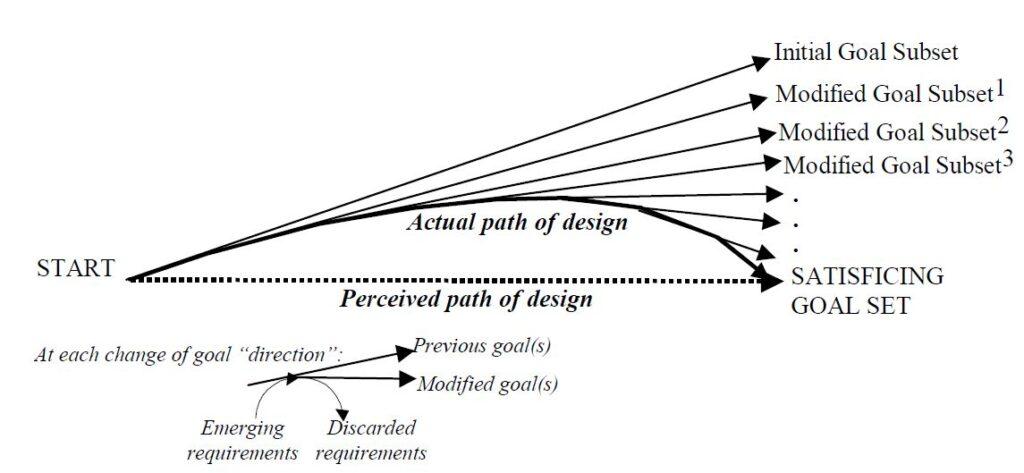
    The collaborative design of system solutions for wicked problems seems to follow a trajectory of goals, as the group’s understanding of the design progresses. The key to making (and evaluating) progress is understanding what triggers the changes in goal-direction.

    From my research studies, it seems that goal changes are triggered by breakdowns in individual buy-in to the group’s consensus definition of the design vision. Both the breakdowns and the most important parts of the vision are concerned with how the design problem is structured and defined — not (as we usually assume) how the designed system will work. Of course, the solution is important: individual group members constantly test their understanding of the problem against the emerging solution, then realize that the design goals need to change. But it is the consensus problem-vision that drives design goals.

    An important implication of this design model is how to manage design effectively. We need to keep influential decision-makers in the loop, when design goals are redefined, or they just see the start and end points. The natural response is “what took you so long?”. Managing external expectations is key to design success.

    This blog discusses how we design information system solutions for real-world problems.