
Category: Boundary-Spanning Knowledge

Knowledge that spans organizational or domain boundaries

  • Small World Information Bubbles

    Small World Information Bubbles

    Small World Information Bubbles

    Information Bubbles

    We all live in an information bubble. Not because we are unaware of alternative perspectives, but because we prefer the perspectives of our “tribe” (or in-group).
    Fox News, CNN, and MSNBC are filling the trust hole left by eroding community life. Increasingly, extremist online media groups and politicized TV networks are exploiting the vacuum left by abolishing the fairness doctrine. There is no requirement for media sources to be balanced or objective in their presentation of news or facts [1].

    In the 1970s, 80s, and 90s research demonstrated that people only read newspapers that aligned with their political point-of-view (Knobloch-Westerwick et al, 2019). Now people seek out media, TV, and online news sources that align with their existing perspective – or are served with reinforcing points of view via social media filtering mechanisms.

    A filter bubble is the state of intellectual isolation that arises when personalized searches, recommendation systems, and algorithmic curation selectively presents information to each individual user (Pariser, 2011).

    Elfreda Chatman’s “Small World” Findings

    Elfreda Chatman (1991) showed how people in working class and marginalized communities prefer news from friends & neighbors to external sources. She described the world that less-educated or impoverished individuals inhabit, using six aspects of information-seeking. Chatman argues that poor and less-educated individuals tend to:

    1. Live life in a small world

    Information originating outside of their local circle of contacts holds little of interest for the lower class. Their information access is driven by the combination of living in a risky environment, life at the margin of influence and social participation, and “the awareness that if one wants acceptance, future goals and aspirations must be constrained by the standards of one’s family and friends.”

    2. Have lower expectations of success

    People in marginalized and poorer communities believe their success is governed by luck rather than opportunity or skill.

    3. Seek information only from direct or trusted contacts

    People (generally) prefer to seek information mainly from others like themselves, and are skeptical of claims not personally experienced. They view external perceptions about reality as not adequate, trustworthy, or reliable, which limits exposure to new possibilities or education.

    4. Have a limited-time horizon

    Their lifestyle is present rather than future focused. They base decisions on “the immediate present and the very recent past” rather than planning for the future.

    5. Have an insider’s worldview

    People in marginalized and poorer communities view the outside world as unpredictable and hostile. There is an “us vs. them” mentality, where people residing outside of one’s familiar surroundings are viewed with suspicion.

    6. Use the mass media differently than do higher socioeconomic classes.

    Marginalized people are heavy television viewers: “mass media, particularly television, is viewed as a medium of escape, stimulation, and fantasy” rather than an information source. They perceive news to be a reflection of events that occur locally and so they are more likely to be “mistrustful of others and afraid of being victims of crime.” They keep dogs and guns for protection.

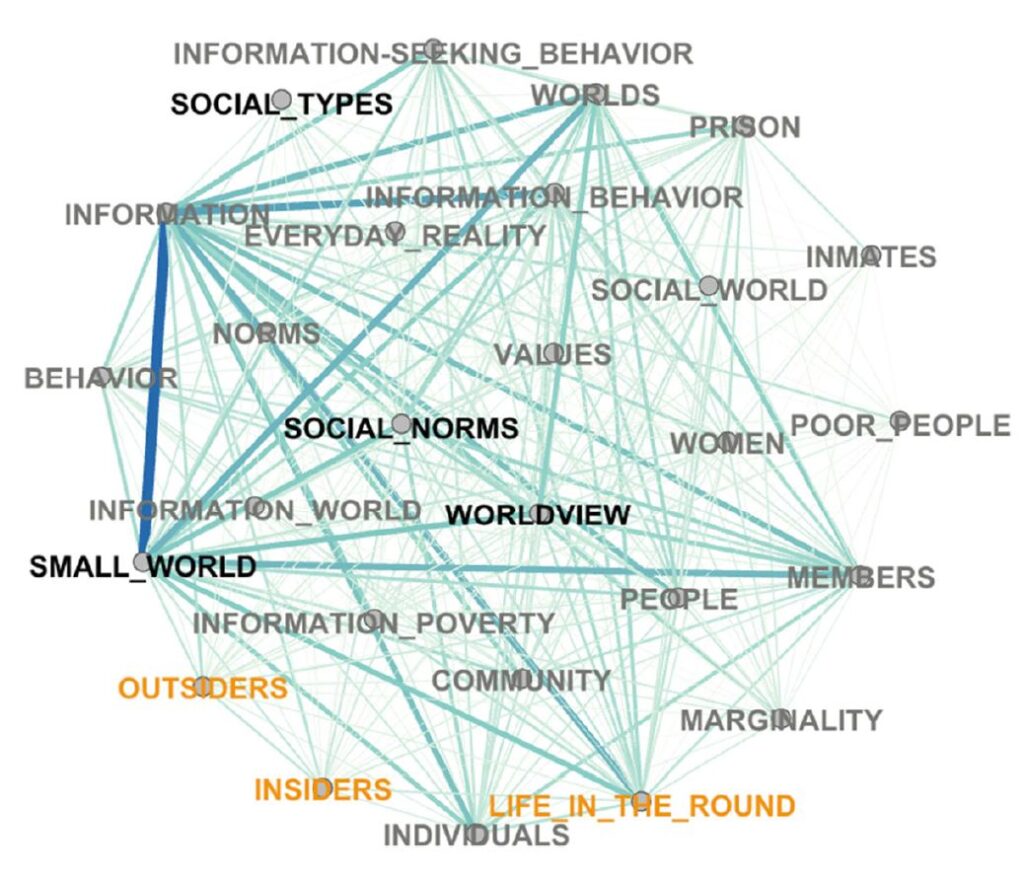
    Chatman’s (1991) Small World theory has proved highly influential, as shown in Figure 1. This theory has been used to demonstrate how – because evaluating information in an online world is so complex – people tend to rely on members of their local community, or online influencers trusted by local community members, as sources of reliable information (Chowdhury & Chowdhury, 2013).
    Life in the round theory influence network

    Figure 2. Influence of Chatman’s “Small World” Information Theory
    (Gonza´lez-Teruel & Abad-Garcı´a, 2018)

    Chatman’s “small world” theory explains why Fox News is so subversive to society: it markets itself as the sole purveyor of truth and plays on distrust of people outside the group by pretending that their privileged journalists are just like “ordinary people.” Members of marginalized and poorer communities consume news as a medium of entertainment – they are relatively uneducated and can be indoctrinated without realizing it, as this Fox News presents perspectives from “people like us.” When trying to get a broadcast license in the UK, from where they were banned, Fox News described their content as entertainment, rather than news.

    Filter Bubbles in Online Communities

    Because social media and news media are driven by algorithm or network-connected interaction, they create a “small world” network for everyone, regardless of social class. On social media platforms, algorithms and the need to develop networks of regular social contacts can inadvertently isolate a user into an ideological filter bubble (Pariser, 2011), by only serving them information that it thinks they want to see. For example, Meta (Facebook, Instagram, and Threads) curate their posts to match them to posts on similar topics, or containing similar keywords and sentiment-related modifiers that users have sought out previously [2]. If you “like” posts from a particular perspective, those are all that you will see. Two examples of filtering mechanisms are:

    • On Threads, a Meta social media site which uses a preference-oriented algorithm to display posts for each user, there has been a lot of discussion about how the algorithm rewards people who “like” posts to sympathize with those whose dog or cat has just died, with a depressing, never-ending stream of posts about dead or dying pets.
    • On platforms with no filtering algorithm, such as Bluesky, the need to follow other users in order to obtain visibility and online-interaction imposes its own filter bubble, as people tend to follow those with similar perspectives to their own (people whose posts they enjoy reading).

    This creates an online small-world – an automated filter-bubble. Because of their limited, ideological information preferences, it is difficult to introduce people to alternative points of view. They see alternative ideological viewpoints – including factual support for counter-perspectives – as dishonest or subversive. When confronted by cognitive dissonance, they reframe the “facts” to fit with their beliefs, because of the importance of local community perspectives in their world. They engage in defense mechanisms such as avoidance, denial, or cherry-picking sources. Dissonance research has demonstrated that people are more willing to examine materials that confirm their beliefs than materials that dispute their beliefs. reinforcing their filter-bubble (and confirming research from previous decades). People become isolated in a filter-bubble of limited information sources, of which they are largely unaware.

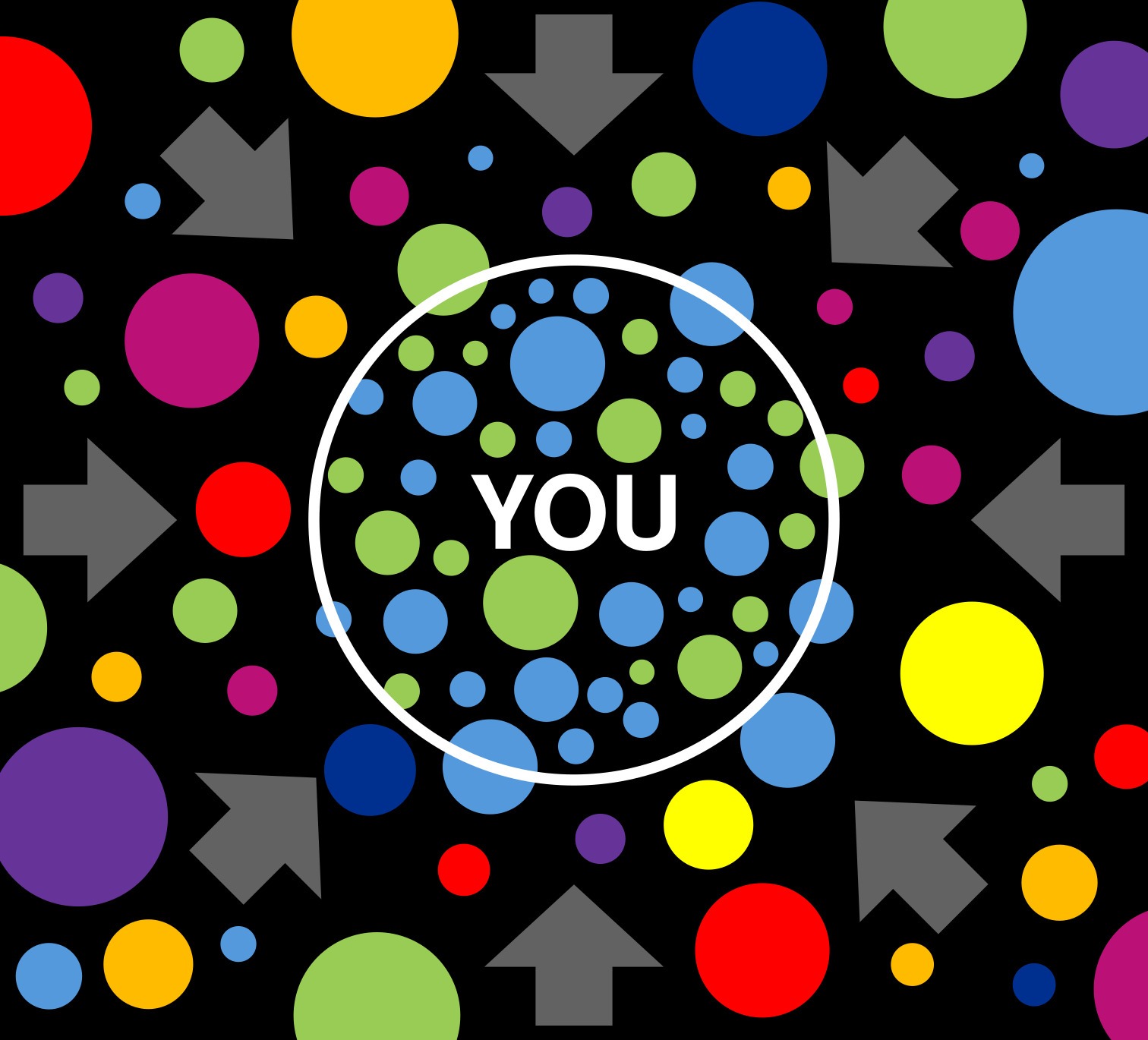
    Diagram representing an online filter bubble allowing some types of information through, but not others.

    Figure 2. In an ideological filter bubble, indicated by the circle, exchange of information is closed, limited to a prescribed network of influences, and insulated from rebuttal (Wikipedia)

    Social media algorithms and network-association mechanisms (such as following people whose posts you prefer) can inadvertently isolate a user into an ideological filter bubble, by only serving them information that it thinks they want to see. It is important to actively seek out diverse sources of information and – when countering disinformation in a community – to introduce countervailing information (such as data on the efficacy of vaccination) via trusted community influencers, rather than presenting people with external, unvouched for scientific evidence.

    Notes

    [1] Kellyanne Conway, a public relations and media influencer working for Donald Trump, famously coined the phrase “alternative facts” to reflect ideological perspectives for which there was no objective evidence.
    https://en.wikipedia.org/wiki/Alternative_facts

    [2] An example of sentiment-analysis is associating a modifier such as “demented” with a keyword such as “president.” Posts containing both terms will be ranked as more attractive to the user than posts without them, if the user has “liked” posts with similar sentiment-terms previously.

    Reference

    Chatman, E. A. (1991). Life in a small world: Applicability of gratification theory to information-seeking behavior. Journal of the American Society for Information Science, 42, 438–449.
    https://doi.org/10.1002/(SICI)1097-4571(199107)42:6<438::AID-ASI6>3.0.CO;2-B

    Chowdhury, G. G., & Chowdhury, S. (2013). Human information behaviour studies and models. In Information Users and Usability in the Digital Age (pp. 55–84). Facet Publishing.
    https://doi.org/10.29085/9781856049757.004

    Gonza´lez-Teruel & Abad-Garcı´a (2018) The influence of Elfreda Chatman’s theories: a citation context analysisScientometrics (2018) 117:1793-1819
    https://doi.org/10.1007/s11192-018-2915-3

    Harmon-Jones, E., & Harmon-Jones, C. (2007). Cognitive dissonance theory after 50 years of development. Zeitschrift für Sozialpsychologie, 38(1), 7-16. Downloaded 5/12/2026 from
    https://www.researchgate.net/profile/Eddie-Harmon-Jones/publication/255581596_Cognitive_Dissonance_Theory_After_50_Years_of_Development/links/638e8e53484e65005be6c4a8/Cognitive-Dissonance-Theory-After-50-Years-of-Development.pdf

    Knobloch-Westerwick, S., Westerwick, A., & Sude, D. J. (2019). Media choice and selective exposure. In Media effects (pp. 146-162). Routledge. Downloaded 5/12/2026 from
    https://kimliaa.wordpress.com/wp-content/uploads/2021/10/routledge_communication_series_mary_beth_oliver_arthur_a._raney_jennings_bryant_-_media_effects__adv.pdf#page=157

    Pariser, E. (2011). The filter bubble: How the new personalized web is changing what we read and how we think. Penguin.

    Wikipedia (2015) Filter bubble. Accessed 5/12/2026 at https://en.wikipedia.org/wiki/Filter_bubble. Graphic source Original: Evbestie Vector: Dabmasterars, CC BY-SA 4.0 https://creativecommons.org/licenses/by-sa/4.0, via Wikimedia Commons

  • The Impact of Boundary Selection

    Analysis, design, and problem-solving depend on pattern recognition. When organizations assemble a team of managers or designers to represent different business groups, each person brings the assumptions of their group culture and “best practices” with them. They are expected to collaborate as if they totally understand every single part of every business practice involved. But there are multiple, interrelated problems involved in any situation and different stakeholders will perceive different problems depending on their background, their experience of the business, and their place in the organization (what problems affect them). The key skill is to recognize those problems and tease them apart, dealing with each one separately.

    Organizational problems – whether operational or strategic – typically span organizational boundaries, so the design of business processes and enterprise systems is complicated. Boundary-spanning systems of work need systemic methods and solutions. The point is to understand how collaboration works when people lack a shared context or understanding — and to use design approaches that support collaborative problem investigation, to increase the degree of shared understanding as the basis for consensus and action in organizational change. To enable collaborative visions, people need some point of intersection. In typical collaborations – for example a design group working on change requirements – the “shared vision” looks something like Figure 1.

    Venn diagram, showing intersubjective frames, intersections of understanding between 2 stakeholders, and distributed cognition as the union of all frames

    Figure 1. Differences Between Individual, Shared, and Distributed Understanding In Boundary-Spanning Groups

    The only really shared part of the group vision is the shaded area in the center. The rest is a mixture of partly-understood agreements and consensus that mean different things to different people, depending on their work background, their life experience, education, and the language they have learned to use. For example, accountants use the word “process” totally different to engineers. Psychologists use it to define a different concept from either group. When group members perceive that others are not buying in to the “obvious” consequences of a shared agreement, they think this is political behavior — when in fact, it most likely results from differences in how the situation and group agreements are interpreted.

    Boundary-spanning collaboration is about maximizing the intersections of understanding using techniques such as developing shared representations and prototypes, to test and explore what group members mean by the requirements they suggested. It involves developing group relationships to allow group members to delegate areas of the design to someone they deem knowledgeable and trustworthy. It uses methods to “surface” assumptions and to expose differences in framing, in non-confrontational ways. But most of all, it involves processes to explore group definitions of the change problem, in tandem with emerging solutions. We have understood this for a long time: Enid Mumford, writing in the 1970s and 80s, discussed the importance of design approaches that involved those who worked in the situation, and the need to balance job design and satisfaction with the “bottom line interests” of IT system design (Mumford and Weir 1979; Mumford 2003) – also see Porra & Hirchheim (2007). This theme has been echoed by a succession of design process researchers: Horst Rittell (Rittel 1972; Rittel and Webber 1973), Peter Checkland (1999), and Stanford’s Design Thinking initiative (although “design thinking” tends to be co-opted to focus on “creativity” in interface design, rather than the integrative design approach that may have been envisioned).

    The problem is that most collaboration methods for design of organizational and IT-related change employ a decompositional approach. Decomposition fails dramatically because of distributed sensemaking. Group members cannot just share what they know about the problem, because each of them is sensitized by their background and experience to see a different problem (or at least, different aspects of the problem), based on where they are in the organization. Goals for change evolve, as stakeholders piece together what they collectively know about the problem-situation — a process akin to assembling a jigsaw-puzzle. This is where boundaries become pertinent.

    Figure 2 shows a (simplified) rich picture of the context in which a University library operates. If we wish to make changes to the library systems, there are a number of boundaries that we might consider:

    • Services available to students and faculty within the physical University Library building. Books and periodicals (academic articles) are accessed by University students and faculty, both locally and remotely (by providing digital, online resources).
    • The selection of the physical building may exclude wider access by members of the public. So we might extend the boundary to include selected members who pay a subscription fee, or who are eligible for membership because they live in the local area of the campus.
    • However, a University Library cannot subscribe to every book and periodical in existence. Most University Libraries share the cost by making their resources available to other Universities through the Inter-Library Loan system. Including such loans (and virtual access) in the services we are supporting with our redesigned system or processes would need us to adopt an alternate system boundary that includes interactions with other University Libraries.
    • Within the system boundary, we may need to include the providers or online resources: research databases, journals, and e-books. Otherwise, we cannot access the resources that we subscribe to.
    • Finally, we probably need to maintain relationships with public libraries. These often provide access to a range of items – movies, popular magazines, popular fiction, etc. – that our students and faculty would want access to. We would probably need to provide reciprocal access to public library patrons in order for our students and faculty to obtain this access.

    Figure 2. A Rich Picture Of The Context In Which A University Library Operates

    The choice of a specific boundary is

    • Functional: what processes or functions are included within the scope of change?
    • Political: who has access to the system and why?
    • Economic: how much does it cost to extend the boundary to other groups or departments, and what benefits do we obtain by doing so?
      and
    • Pragmatic: how do we manage the diverse expectations and cultures of different groups or categories of user?

    It is important not to just assume a specific boundary – boundaries are important and selecting too limited a boundary is a common problem in IT-related change where analysts are trained to focus on a single problem, with a simple boundary. Mapping out the scope and boundaries of the systems of work needing improvement is a key skill that analysts increasingly need to acquire. It is also important to recognize that boundaries require negotiation and facilitated communication across stakeholders. People in different parts of the organization see different problems – they fail to recognize that their problems are related to those of people in other parts of the organization. This can only be overcome by holding group workshops to explore these relationships.

    Stakeholders for change often lack a common language for collaboration. They come from different functional groups, with different conventions used to represent problems. Facilitation of group processes is critical because (productive) conflict and explicit boundary negotiation tend to be avoided in boundary-spanning change groups. Misunderstandings are ascribed to political game-playing, rather than a lack of appreciation of the diverse business processes and functional groups that need to be spanned. To fix this, we need design and problem-solving approaches that support the distributed knowledge processes underpinning change and innovation — approaches that recognize and embrace problem emergence, boundary-negotiation, and the development of shared understanding.

    References

    Balcaitis, Ramunas 2019. What is Design Thinking? Empathize@IT https://empathizeit.com/what-is-design-thinking/. Accessed 8-15-2023.

    Checkland, P. 1999. Systems Thinking Systems Practice: Includes a 30 Year Retrospective, (2nd. Edition ed.). Chichester UK: John Wiley & Sons.
    [Original edition of this book published in 1981].

    Mumford, E. 2003. Redesigning Human Systems. Hershey, PA: Idea Group.
    Mumford, E. and Weir, M. 1979. Computer Systems in Work Design: The Ethics Method. New York NY: John Wiley.

    Porra, J., & Hirschheim, R. 2007. A lifetime of theory and action on the ethical use of computers: A dialogue with Enid Mumford. Journal of the Association for Information Systems, 8(9), 3.

    Roumani, Nadia 2022. Integrative Design: A Practice to Tackle Complex Challenges, Stanford d.school on Medium, Accessed 8-15-2023.

    Rittel, H.W.J. 1972. “Second Generation Design Methods,” DMG Occasional Paper 1. Reprinted in N. Cross (Ed.) 1984. Developments in Design Methodology, J. Wiley & Sons, Chichester: 317-327.

    Rittel, H.W.J. and Webber, M.M. 1973. “Dilemmas in a General Theory of Planning,” Policy Sciences (4), pp. 155-169.

  • Boundary-Spanning Design

    As we become more experienced in the professional practice of our organizational function, we build a repertoire of “recipes for success” — mental models that indicate what methods to use for solving various types of problem, and criteria for evaluating how well we succeeded in achieving specific outcomes.

    Assemble a group of people from different functions – for example the typical project group or management taskforce that is used for problem-situations that span organizational boundaries and you discover that its members’ perspectives diverge – and often conflict.

    Organizational boundaries separate communities of practice: groups with distinct ways of working, with separate cultures, values, and goals. Various functional or specialist groups (e.g. accounting, marketing, or engineering) have different criteria for success.

    These differences produce confusion and conflict when changes need to span group boundaries for business processes to work. E.g., Marketing often attempt to sell products that are not technically feasible, as they have little understanding of engineering constraints.

    “Consensus planning” is the worst strategy for resolving wicked problems, because it assumes easily-agreed objectives and a one-size-fits-all solution.

    Instead, we need to use problemexploration techniques that allow stakeholders to engage in collaborative learning about what other groups wish to achieve and what work needs to be done to achieve these diverse objectives.

    Appreciative design makes sense of this tangle of complexities, using an interactive approach to incorporate the multiple, mutually inconsistent stakeholder aims into a coherent change plan:

    • It explores the “flow” of work-processes in the area of practice in which we perceive problems;
    • It inquires into and appreciates the context of work, exploring organizational culture, values, and relationships between those involved in the problem-situation;
    • Finally, it produces alternative, context-specific models of work-processes based on competing objectives and cultural values. These act as the basis for discussion across workgroup boundaries.

    Before we start defining how things need to change, it is important to explore the work that is done and the diverse objectives it fulfills.

    Differences in perspective across group boundaries can be understood by exploring interactions between stakeholder groups:

    The diagram shows four types of domain-locale that are spanned to produce organizational expertise, as a 2x2 matrix with the axes: Local (group) vs. Global (Organization); Community of Practice vs. Knowledge Domain (of expertise).
    • The goals, values, and culture of diverse, local communities of practice (e.g. accounting or engineering) vs. those of global (organizational) stakeholders such as senior management;
    • The knowledge, practices, and criteria-for-success of various communities of practice vs. the formal standards and expertise assumed in the wider knowledge domain (e.g. accounting).

    The idea is to model and explore what work needs to be done, how, and why. Members of various groups can then understand the wider processes and interactions across group boundaries that make the organization work, buying into changes that make them, collectively, more effective.

    An effective strategy for boundary-spanning design and change-management explores the problem-situation iteratively, incorporating the implicit knowledge that surfaces during investigation, acknowledging multiple ways of framing the situation, and managing evolving strategies, contingencies, and values to produce a coherent set of priorities for change. It involves three, very different types of thinking:

    1

    Co-Design of Business & IT Systems

    Boundary-spanning design is improvisational. We very rarely understand all the requirements for change, even when we start to implement changes to business processes and IT systems. The key skill is an ability to adapt to contingencies, integrating group knowledge across work domains.

    Adaptive planning takes an iterative approach to goal-setting, integrating knowledge about what needs to be done with an evolving appreciation of how the organization works. We center this around an effective business strategy for our company, while prioritizing the work processes that those involved identify.

    Read more on the Co-design of Business & IT Systems

    2

    Systemic Thinking

    In a complex, interconnected world modern organizations need to focus on effectiveness – doing the right thing – rather than the efficiency focus of most design approaches. We still use late 19th century thinking in design, trying to use “scientific management” rather than centering the process on how people need to do their work in order to produce products and services that are responsive to customer needs.

    Systemic thinking takes a “big picture” approach to problem investigation, followed by a “divide-and-conquer” approach to making improvements.

    Read more on Thinking Systemically

    3

    Analyzing Wicked Problems

    In the design of business process and IT change, we typically define a single goal that conflates the multiple, often conflicting, objectives of the work-systems we are trying to improve. Complex problems, that everyone defines differently, are known as wicked problems.
    Focusing on a single goal complicates, rather than simplifies the design of work-systems, as we inevitably have to revisit these goals to accommodate the perspectives that we ignored, reworking the analysis to incorporate the multiple other purposes that people value. Many times, objectives conflict, but we don’t realize this because we only have a vague idea of what these are.

    Human-centered design starts with the work that people need to do, involving them in the redesign. Unless we understand what needs to be done, we can’t design systems to support work.

    Read more on Wicked Problems