I can’t help but reflect on the similarities between research methods, processes and outcomes, and design methods, processes and outcomes. I read an article which argued that there were two types of people: people with tidy offices and people with untidy offices. Tidy-office people are organized and so can find anything they need. These are the people who work top-down, creating an outline then writing or designing according to that scheme. Untidy-office people are disorganized, spend a great deal of time searching for things, but also tend 1 to be more creative because they are inspired by things which they bump into, while looking for other things. These people work bottom-up, assembling elements into a coherent whole. The article argued that there are cognitive rewards in both styles of working, that lead people to subconsciously adopt one or the other style consistently.
I was reflecting on this as I try to make sense of the piles of material that I have assembled for the book. I am definitely an untidy-office type and I wonder if this has something to do with introvert/extrovert personalities? [My project management students and I just explored an online Myers-Briggs personality test; as expected, I was an INTP type.] Perhaps introverts just prefer a “life of the mind,” where we can construct inductive models of the real world?2
My semi-organized and shifting piles of research data, models and representations, interim findings, academic articles, and books provide a three-dimensional, systemic representation of design processes that can be reorganized as I comprehend different patterns. Of course, they are both preceded and supplemented by painstaking (and frequently revisited) processes of categorization, synthesis, and validation. But the kaleidoscope of patterns that they reflect is invaluable in suggesting different views of my findings. The same is true for design – we create the patterns that we perceive as relevant in the problem situation. As our perceptions shift, so do the design patterns that we follow.
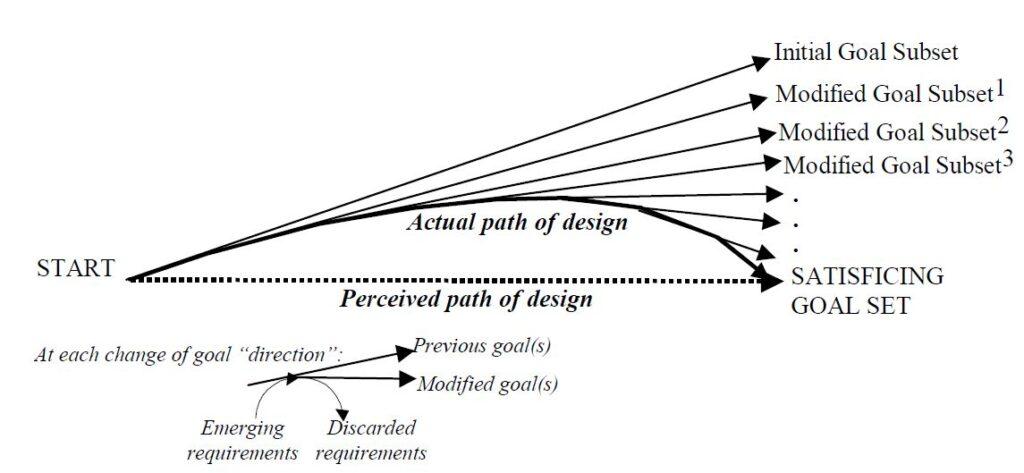
I would argue that innovative design is neither deductive or inductive, but consists of cycles of induction and deduction. It follows a hermeneutic circle of sensemaking, as designers attempt to work from an abstract problem to concrete fragments of a solution that solve those sub-components of the problem that they understand, then relate these back to a meaningful, integrated problem definition. This combination of deductive and inductive thinking has been described as abductive reasoning, but reasoning about design is more disciplined and rigorous than most descriptions of abduction [a hunch] would indicate. I prefer Thagard and Shelley’s (1997) argument that hypotheses about reality are layered, incomplete, and too complex to be comprehended easily3. Often, the only way to comprehend complex, interrelated elements of behavior and context is to use a visual, systemic representation and an iterative process of decomposition into parts of the solution that you understand, integration back to a coherent problem-definition, then back to decomposition until the design as a whole makes some sense.
As someone who has spent a good portion of their career as a systems designer, I have never considered design creative. Design is more about synthesizing from preconceived elements than creating from scratch4. We need to be sensitized to contextually-relevant components of a solution in order to synthesize a design.
So I wonder if – just as in research – the greatest inspiration in design derives from the serendipity of location? Being in the right place, at the right time, to see elements that can be reused in designing a specific solution to a complex and ill-understood problem.
Footnotes (click on ↩ to return to post)
- If anyone knows the reference for this paper, please let me know. I saw an NYT article on the subject, but I can’t locate the academic paper again – which was published in an information science journal, if I recall correctly … ↩︎
- There is a neat discussion of deductive vs. inductive reasoning over at the research methods knowledge base. ↩︎
- Paul Thagard and Cameron Shelley (1997) “Abductive reasoning: Logic, visual thinking, and coherence.” Available at http://cogsci.uwaterloo.ca/Articles/Pages/%7FAbductive.html (last accessed 11/27/2009) ↩︎
- Like sex, design seems to be 30% inspiration and 70% perspiration … ↩︎