
We talk about design as if it were fixed: as if there were one best way to design everything. We celebrate designers who produce especially elegant or usable artifacts as if they were possessed of supernatural powers. Yet design should be easy. It is the application of “best practice” principles to a specific situation. We can observe how the users of a designed artifact or system work, then design the artifact or system accordingly. Why does that approach fail so often?
The key issue is the problem of “the problem.” Designers are taught a repertoire of designs-that-works: patterns that fit specific circumstances and uses. Experienced designers are capable of building up a deep understanding over time, of which problem-elements each of these patterns resolves. So they can assess a situation, recognize familiar problem-elements, then fit these with design patterns that will work in these circumstances. The problem comes when a designer is faced with a novel or unusual situation that they have not encountered before. Novice designers encounter this situation a great deal, but even experienced designers must deal with emergent design in a novel context. In these circumstances, designers iterate their design, as shown in Figure 1. They identify (often partial) problems, ideate/conceive relevant solutions, give those solutions form with a prototype, then evaluate the prototype in context. This often reveals emergent user needs or problems, that are explored in the next iteration.
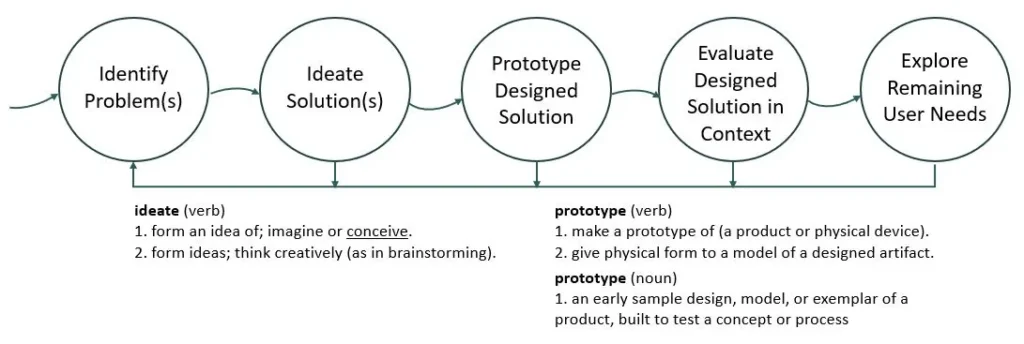
Figure 1. Iterative Design
An important aspect of iterative design is that iterations can occur within cycles. As designers succeed or fail at successive designs, they accumulate experiential knowledge, that allows them to assess new situations quickly and
to understand which design elements will work or fail in that situation, looping back to remediate the design as they spot logical flaws and gaps in the design. The problem with this is that (as the Princess said) you have to kiss an awful lot of frogs to get a Prince. An awful lot of people end up with really bad designs, because their designer did not recognize elements of the situation well enough to understand which pattern-elements to implement. If you are really unlucky, you will also end up with one of those designers who feel it is their mission in life to prevent the end- user “mucking about with” their design. If you are lucky, your designer will recognize that it is your design, not theirs. They design artifacts and systems in ways that allow people to adapt and improvise how they are used.
Which means that design-goals are constantly changing between iterations, as shown in Figure 2. The designer starts by designing for the subset of goals they understand. As they explore and test the design with users, they become aware of new requirements and so modify the subset of goals they are designing for. As part of this process, they also discard any requirements that are no longer associated with perceived user needs.
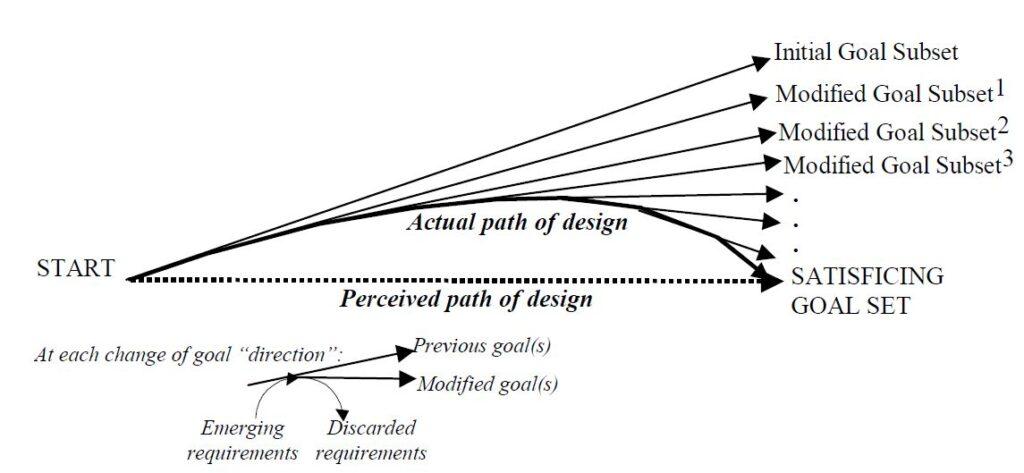
Figure 2. Goal-emergence in design
Improvisation takes a multitude of forms. It might be that a user wishes to customize the color of their screen (because the designer thought that a good interface should look like a play-school). This may not do much for the function of your work-system, but it does mean that your disposition towards work is a heck of a lot sunnier as you use it. Or it might be that the information system which you use expects you to enter data on one step of your work before another. You might be able to enter data into a separate screen for each step, reordering the steps as you wish. More usually, you have to enter fake data into the first step, then go back later to change this, once you have the real data. This is because IT systems designers treat software design as a well-structured problem. A well- structured problem is one that contains the solution within its definition. Defining the problem as a tic-tac-toe game application means that you have a set of rules for how the game is played which absolutely define how it should work. This is fine if everything goes to plan, but a huge pain for users when it does not. The only discretion left to the user is how to format the results in a printed report, which is not much comfort if your whole transaction failed because you were prevented from going back to change one of the inputs. This is not rocket science – developers need to design systems that let users work autonomously.
Business applications tend to present wicked problems . A wicked problem cannot be defined objectively, for all the reasons identified in Figure 3. Solving a wicked problem needs business users and stakeholders to agree on what problems that they face, their priorities in resolving these, and what their change-goals are.
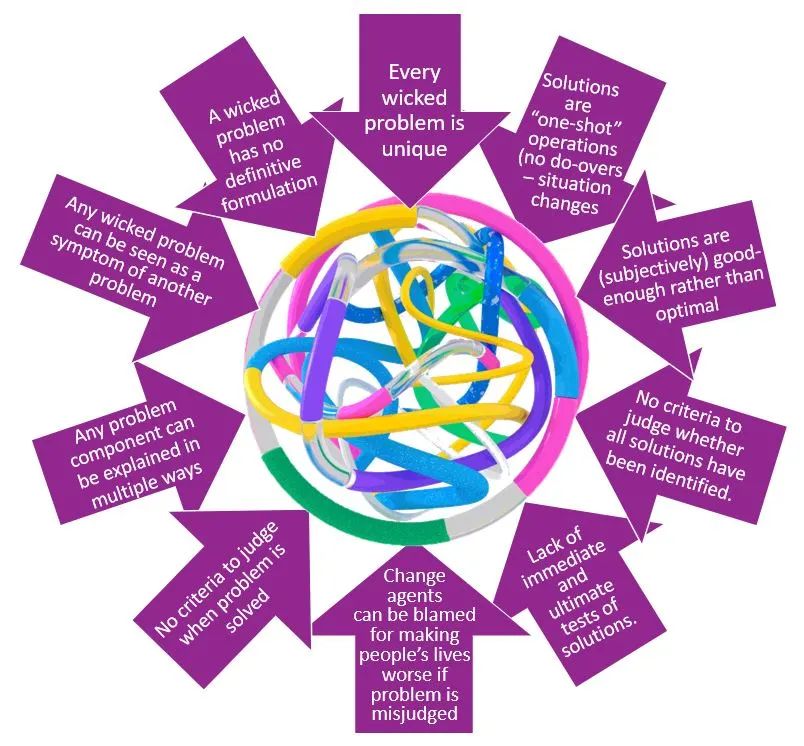
Figure 3. Constraints on Design Posed by Wicked Problems (Rittel & Webber, 1973)
A wicked problem can be understood as a web of interrelated problems. It is not always clear what the consequences will be, of solving any part of this mess. Some of the problems may have “obvious” solutions. But implementing these solutions may make other, related problems worse or better. This is why iterative design is central to resolving wicked problems. In general, stakeholders don’t understand what they need until they see it. So solutions must be designed flexibly, for changes to be implemented as the consequences are realized and to permit adaptation-in-use by stakeholders and users. People are infinitely improvisational. They develop work-arounds and strategies to manage poor design. But, as Norman observes, why should users have to develop work-arounds for poor design? What is it, about the design process, that leads us to such constraining IT systems, interfaces, and work procedures that are based on the system design, rather than system designs that are based on flexible work- procedures?This website reflects findings from my research studies and reflections from my own experience in design, to discuss some key underlying principles of design, to explore how the design process works in practice (rather than how we manage it now, which is based on unsupported theoretical models), and to present a way of managing design differently. … Improvisationally.
References
Norman, D. A. (2013). The Design of Everyday Things: Revised and Expanded Edition. Basic Books, New York.
Rittel, H. W. J., & Webber, M. M. (1973). Dilemmas in a General Theory of Planning. Policy Sciences, 4, 155-169.