Tag: trajectory

  • Improvising Design For Emergent Problems

    Improvising Design For Emergent Problems

    Why is design improvisational?  We talk about design as if it were fixed: as if there were one best way to design everything. We celebrate designers who produce especially elegant or usable artifacts as if they were possessed of supernatural powers. Yet design should be easy. It is the application of “best practice” principles to a specific situation. We can observe how the users of a designed artifact or system work, then design the artifact or system accordingly. Why does that approach fail so often?

    The key issue is the problem of “the problem.” Designers are taught a repertoire of designs-that-works: patterns that fit specific circumstances and uses. Experienced designers are capable of building up a deep understanding over time, of which problem-elements each of these patterns resolves. So they can assess a situation, recognise familiar problem-elements, then fit these with design patterns that will work in these circumstances. The problem comes when a designer is faced with a novel or unusual situation that they have not encountered before. Novice designers encounter this situation a great deal. As designers succeed or fail at successive designs, they accumulate experiential knowledge, that allows them to assess new situations quickly and to understand which design elements will work or fail in that situation. The problem with this is that (as the Princess said) you have to kiss an awful lot of frogs to get a Prince. An awful lot of people end up with really bad designs, because their designer did not recognize elements of the situation well enough to understand which pattern-elements to implement. If you are really unlucky, you will also end up with one of those designers who feel it is their mission in life to prevent the end-user “mucking about with” their design. If you are lucky, your designer will recognize that it is your design, not theirs. They design artifacts and systems in ways that allow people to improvise how they are used — and the role that they play in the work that people do.

    Improvisation takes a multitude of forms. It might be that you customize the color of your screen (often because the designer thought that a good interface should look like a play-school). This may not do much for the function of your work-system, but it does mean that your disposition towards work is a heck of a lot sunnier as you use it. Or it might be that the information system which you use expects you to enter data on one step of your work before another. You might be able to enter data into a separate screen for each step, reordering the steps as you wish. More usually, you have to enter fake data into the first step, then go back later to change this, once you have the real data. This is because IT systems designers treat software design as a well-structured problem. A well-structured problem is one that contains the solution within its definition. Defining the problem as a tic-tac-toe game application means that you have a set of rules for how the game is played which absolutely define how it should work. The only discretion left to the designer is whether to support one or two players and how to present the functions in a usable screen interface. This is not rocket science: most designers can manage this level of design without making the game unusable.

    But information systems applications tend to present wicked problems. A wicked problem is a problem that cannot be defined objectively, but needs the people involved (the stakeholders) to agree on what the problems that they face are, what are their priorities in resolving these, and what they want to achieve in changing things in the first place. A wicked problem can be understood as a web of interrelated problems. It is not always clear what the consequences will be, of solving any part of this mess. Some of the problems may have “obvious” solutions. But implementing these solutions may make other, related problems worse or better. For example, consider the problem of providing State-based unemployment benefit in the USA (see the diagram on the “systems thinking” page). If one State offers such benefits and a neighboring State does not, unemployed people will move to the State which does offer benefit payments. This will place a greater tax burden on that State, causing the more affluent residents and businesses to move out. This increases unemployment, raising the tax burden, causing more people and businesses to move out. The act of offering State-based unemployment benefits leads that State into a downward spiral in which their budget becomes unmaintainable and employment opportunities are significantly reduced. For wicked problems, a wider perspective is needed, that examines interactions between problem elements and which analyzes the impact of one problem-solution on other problems. It is not always possible to foresee all unintended consequences. So solutions must be designed flexibly, for changes to be implemented as the consequences are realized and to permit customization by stakeholders and users.

    People are infinitely improvisational. They develop work-arounds and strategies to manage poor design. But I constantly ask myself why should they have to develop work-arounds for poor design? What is it, about the design process, that leads us to such constraining IT systems, interfaces, and work procedures that are based on the system design, rather than system designs that are based on flexible work-procedures? This website reflects findings from my research studies and reflections from my own experience in design, to discuss some key underlying principles of design, to explore how the design process works in practice (rather than how we manage it now, which is based on unsupported theoretical models), and to present a way of managing design differently.  Improvisationally.

  • On Realizing The Relevance of Actor-Network Theory

    On Realizing The Relevance of Actor-Network Theory

    A recent emphasis on sociomateriality appears to have entered the IS literature because of discussions by Orlikowski (2010) and the excellent empirical study of Volkoff et al. (2007). Now that people have been sensitized to the literature on material practice, actor-network theory is classified as “tired and uninformative” [1]. Which leads me to wonder just how many IS academics have actually read the actor-network theorists? Or pondered how this applies to technology design?

    Long before people started discussing socio-material “assemblages,” Bruno Latour (1987)and John Law (1987) were discussing how technology developed by means of “heterogeneous networks” of material and human actants, the combination of which directs the trajectory of technology design and form. Latour (1999) suggests that he should recall the term “actor-network,” as this is too easily confused with the world-wide web. Yet actor-networking – in the sense of a web of connectivity, where heterogeneous interactions between diverse individuals, between virtually-mediated groups, and between individuals and material forms of embedded intentionality – is exactly what is going on in today’s organizations.

    In addition, Michel Callon’s (1986) work on how the “problematization” of a situation in ways that aligns the interests of others leads to their enrolment in a network of support for a specific technological frame. Once support has been enrolled, such networks endow irreversibility, which makes changes to the accepted form of a technology solution incredibly difficult. So we have paradigms that are embedded in a specific design. Akrich coined the term “script” to define the performativity of technology and the term was adopted by the other leading actor-network theorists [2]. This thread of work articulates incredibly deeply the ways in which technology design directs its users (and maintainers) into a set of roles and worldviews that are difficult to escape. We must “de-script” technology to repurpose it to other networks and other applications – which is much more difficult than one would suppose, given the embedded social worlds that are carried across networks of practice with the use of common technologies (Akrich 1992).
    So what does actor-network theory give us? It provides a conceptual and practical approach to understanding and modeling why design takes specific forms – and what needs to be “undone” for a design to be conceived differently than in the past [3]. It provides a rationale for understanding technology as a network actor in its own right, influencing behavior and constraining discovery. The assumptional frameworks for action embedded in – for example – a software book-pricing application will direct the evaluation of price alternatives in ways that reflects the model of decision-making adopted by the software’s author. This results in the type of stupid automaticity that recently saw an Amazon book priced at $23,698,655.93 (plus $3.99 shipping). The cause of this pricing glitch was traced back to an actor-network of two competing sellers, unknowingly connected via their use of the same automated pricing software [4].

    Finally, I want to observe that a lot of the recent “materiality of practice” literature has identified new phenomena and new mechanisms of actor-networks. For example Knorr Cetina (1999) has sensitized us to how epistemology is embedded in socio-technical assemblages, Rheinberger (1997) has demonstrated how some technical objects are associated with emergence while others enforce standardization and Henderson (1999) demonstrates how the use of specific representations can conscript others around an organizational power-base. But I would argue that these effects can be understood by using Actor-Network Theory as one’s underpinning epistemology – and that exploring actor-network interactions continues to reveal ever newer mechanisms that are relevant to how we work today. I would strongly recommend Bruno Latour’s latest book, Reassembling The Social.

    Notes:
    [1] I have to declare an interest here – this comment was contained in a review of one of my papers … 🙂
    [2] As Latour (1992) argues: “Following Madeleine Akrich’s lead (Akrich 1992), we will speak only in terms of scripts or scenes or scenarios … played by human or nonhuman actants, which may be either figurative or nonfigurative.”
    [3] One of my favorite papers on the topic of irreversibility in design is ‘How The Refrigerator Got Its Hum,’ by Ruth Cowan (1995). Another good read is the introduction to the same book by MacKenzie and Wajcman (1999).
    [4] The amusing outcome is recounted by Michael Eisen, at http://www.michaeleisen.org/blog/?p=358

    References:
    Akrich, M. 1992. The De-Scription Of Technical Objects. W.E. Bijker, J. Law, eds. Shaping Technology/Building Society: Studies In Sociotechnical Change. MIT Press, Cambridge, MA, 205-224.
    Callon, M. 1986. “Some elements of a sociology of translation: domestication of the scallops and the fishermen of St Brieuc Bay.” J. Law, ed. Power, Action, and Belief: a New Sociology of Knowledge? Socioogical Review Monograph 32. Routledge and Kegan Paul, London, 196-233.
    Cowan, R.S. 1995. “How the Refrigerator Got its Hum.” D. Mackenzie, J. Wajcman, eds. The Social Shaping of Technology. Open University Press, Buckingham UK, 281-300.
    Henderson, K. 1999. On Line and on Paper: Visual Representations, Visual Culture,and Computer Graphics in Design Engineering. MIT Press, Harvard MA.
    Knorr Cetina, K.D. 1999. Epistemic Cultures: How the Sciences Make Knowledge. Harvard Univ. Press, Cambridge, MA.
    Latour, B. 1987. Science in Action. Harvard University Press, Cambridge MA.
    Latour, B. 1992. “Where Are the Missing Masses? The Sociology of a Few Mundane Artifacts.” W.E. Bijker, J. Law, eds. Shaping Technology/Building Society: Studies In Sociotechnical Change. MIT Press, Cambridge MA.
    Latour, B. 1999. “On Recalling ANT.” J. Law, J. Hassard, eds. Actor Network and After. Blackwell, Oxford, UK 15-25.
    Law, J. 1987. “Technology and Heterogeneous Engineering – The Case Of Portugese Expansion.” W.E. Bijker, T.P. Hughes, T.J. Pinch, eds. The Social Construction of Technological Systems: New Directions in the Sociology and History of Technology. MIT Press, Cambridge MA.
    MacKenzie, D.A., J. Wajcman. 1999. Introductory Essay. D.A. Mackenzie, J. Wajcman, eds. The Social Shaping Of Technology, 2nd. ed. Open University Press, Milton Keynes UK, 3-27.
    Orlikowski, W. 2010. “The sociomateriality of organisational life: considering technology in management research.” Cambridge Journal of Economics 34(1) 125-141.
    Rheinberger, H.-J. 1997. Experimental Systems and Epistemic Things Toward a History of Epistemic Things: Synthesizing Proteins in the Test Tube. Stanford University Press, Stanford CA, 24-37.
    Volkoff, O., D.M. Strong, M.B. Elmes. 2007. “Technological Embeddedness and Organizational Change.” Organization Science 18(5) 832-848.

  • Double Loop Learning in Design

    Double Loop Learning in Design

    Double-loop learning occurs when we question the values, assumptions and recipes-for-success that we typically apply to a situation. This type of paradigm-shift is essential when the business environment, or the context of work changes.
    Typically, we learn how to do something well and we keep on applying that recipe-for-success. It is called expertise. We are proud of the knowledge and experience that led to our becoming an expert and so we tend not to question this. But when things change, expertise can become a handicap.

  • Design as a trajectory of goal-definitions

    Design as a trajectory of goal-definitions

    The focus of IS design has moved “upstream” of the waterfall model, from technical design to the co-design of business-processes and IT systems.  This focus requires an improvisational design approach.  IT-related organizational innovation deals with wicked problems

    Wicked problems tend to span functional and organizational boundaries as business process and information management problems are intertwined.  There are clusters of interrelated problems:  these cannot be defined objectively because the problem is defined differently, depending on who you ask.  IS designers cannot analyze this type of problem in isolation – we need to involve diverse groups of stakeholders in negotiating suitable problem definitions and boundaries for change.  But wicked problems also involve distributed knowledge, where understanding of the problems is stretched across (rather than shared between) stakeholders. 

    So design goals evolve, as designers and stakeholders learn more about the context and the problems facing the organization by engaging in incremental change.   This is often approached by means of agile design methods. But our lack of understanding about how to establish a “common language” for this type of design means that information system innovation tends to be pretty hit-and-miss. Most design initiatives spend more time arguing about process definitions than achieving change. We need a new approach that focuses on the co-design of business (process) and IT systems: a collaborative process that involves problem stakeholders as collaborators in analyzing change. This is the basis of improvisational design.

    Goal Emergence in Design

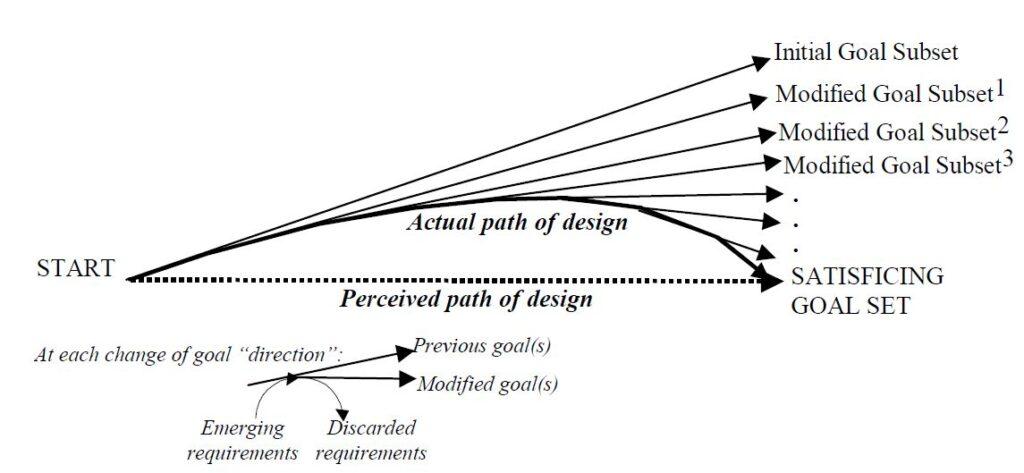
    The collaborative design of system solutions for wicked problems seems to follow a trajectory of goals, as the group’s understanding of the design progresses. The key to making (and evaluating) progress is understanding what triggers the changes in goal-direction.

    From my research studies, it seems that goal changes are triggered by breakdowns in individual buy-in to the group’s consensus definition of the design vision. Both the breakdowns and the most important parts of the vision are concerned with how the design problem is structured and defined — not (as we usually assume) how the designed system will work. Of course, the solution is important: individual group members constantly test their understanding of the problem against the emerging solution, then realize that the design goals need to change. But it is the consensus problem-vision that drives design goals.

    An important implication of this design model is how to manage design effectively. We need to keep influential decision-makers in the loop, when design goals are redefined, or they just see the start and end points. The natural response is “what took you so long?”. Managing external expectations is key to design success.

    This blog discusses how we design information system solutions for real-world problems.